Referatai
Collaboration


Collaboration exists when key personnel from different institutions have substantive involvement in the development and performance of the scientific aspects of a project and the sponsor chooses to make only one award, thereby requiring the lead institution to issue subcontracts or sub grants to the other collaborating institutions.
3. Governance: we agree that our behavior can be regulated according to shared or stated values;
4. Groups: we can relate to each other in smaller numbers;
5. Environment: we interact in shared space that is appropriate to our goals;
6. Boundaries: we know who belongs and who doesn’t;
7. Trust: we know with whom we’re dealing and that it’s safe to do so;
8. Exchange: we can trade knowledge, support, goods, services, and ideas;
9. Expression: we have a group identity and know what other members are doing. We can easily indicate our preferences and opinions;
10. History: we can look back over our history and track our evolution.
Some of the potential benefits from collaboration include:
1. Effective and efficient program delivery;
2. Improved professional development;
3. Improved communication
4. Elimination of duplication;
5. Increased use of programs;
6. Improved public image;
7. Better needs assessment;
8. Consistency of information;
9. Increased availability of resources
Despite these benefits, there are also many challenges and barriers that must be overcome when trying to collaborate with other groups. These include:
1. Turf protection and mistrust
2. Decision-making processes
3. Limited resources
4. Dropping out
5. Reduced participation
6. Broad representation
7. Communication
8. Solid leadership
9. Time commitment
If company will collaborate with other company there can be changes in profit, labor, customers. Company must carefully choose people for collaboration, because from them depends it will be useful for company or not. For smoother collaboration:
1. Extend the power.
2. Automate to collaborate.
3. Enforce corporate policies.
4. Delegate administration.
5. Safely open the back door.
6. Know the users.
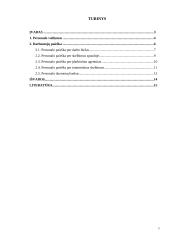
CONTENTS
Executive summary 2
Introduction 4
1. What is collaboration? 6
2. Principles of collaboration 8
THE FIRST PRINCIPLE: PURPOSE 8
THE SECOND PRINCIPLE:...
Šį darbą sudaro 5422 žodžiai, tikrai rasi tai, ko ieškai!
★ Klientai rekomenduoja
Šį rašto darbą rekomenduoja mūsų klientai. Ką tai reiškia?
Mūsų svetainėje pateikiama dešimtys tūkstančių skirtingų rašto darbų, kuriuos įkėlė daugybė moksleivių ir studentų su skirtingais gabumais. Būtent šis rašto darbas yra patikrintas specialistų ir rekomenduojamas kitų klientų, kurie po atsisiuntimo įvertino šį mokslo darbą teigiamai. Todėl galite būti tikri, kad šis pasirinkimas geriausias!
Norint atsisiųsti šį darbą spausk ☞ Peržiūrėti darbą mygtuką!
- Personalo vadybos referatas
- 21 psl., (5422 ž.)
- Word failas 108 KB
- ✅ Yra šaltiniai
 Atsisiųsti šį referatą
Mūsų mokslo darbų bazėje yra daugybė įvairių mokslo darbų, todėl tikrai atrasi sau tinkamą!
 Kiti darbai


Privalumai
 Darbo pakeitimo garantija
Atsisiuntei rašto darbą ir neradai jame reikalingos informacijos? Pakeisime jį kitu nemokamai.
 Gauk 25% nuolaidą
Pirkdamas daugiau nei vieną darbą, nuo sekančių darbų gausi 25% nuolaidą.
 Greitas aptarnavimas
Išsirink norimus rašto darbus ir gauk juos akimirksniu po sėkmingo apmokėjimo!
Atsiliepimai