Referatai
Religious education in Lithuania


Circumstances of Development of Institutional Education in Lithuania
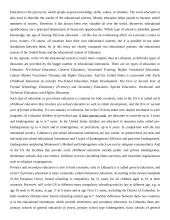
The XIV century is held to be the beginning of the development of institutional education in Lithuania. A surviving 1397 document attests to the existence of a school, functioning at the Vilnius Cathedral.
Education was under the cultural domain of the Church during the Middle Ages in Lithuania, as well as throughout all of Europe. The official Act of Christianity, introduced by Jogaila and Vytautas, was dated in 1387. Lithuania accepted Christianity later than other European countries. Thus, it may also be concluded that the system of institutional education also developed later, and was chiefly aimed at the training of the clergy.
Religious education and moral education in text books
In Lithuanian basic schools religious education is realized by teaching the subject
‘Faith’ for grades 5-10. This subject is based on the values and doctrine of
the Christian Catholic faith. Teachers are confirmed and accredited by the catechetic
centre of the Catholic Church. It is an elective subject. The parents of students have
an opportunity to choose from either the Christian Catholic Faith or Ethics. The
subjects are similar because both have elements of religious and moral education.
Textbooks of religious education (‘Faith‘) have been chosen for the analysis. After
content analysis of 6 textbooks for grades 5-10 several dimensions of citizenship and
morality have been found. These dimensions are presented here according to the
frequency of their occurrence in the textbooks (see Figure 1).
The first dimension of citizenship found in religious education textbooks is national
identity. The issues of national identity are revealed as a direct or indirect idea of the
topic. As a direct element it is found in narrations of important Lithuanian historical
events, in discussions and stories about national, traditional customs and holidays,
Lithuanian symbols and their symbolic meanings, legends, pagan rituals and pagan
deities. Students are introduced to the establishment and development of Lithuanian
parishes, dioceses...
Šį darbą sudaro 1921 žodžiai, tikrai rasi tai, ko ieškai!
★ Klientai rekomenduoja
Šį rašto darbą rekomenduoja mūsų klientai. Ką tai reiškia?
Mūsų svetainėje pateikiama dešimtys tūkstančių skirtingų rašto darbų, kuriuos įkėlė daugybė moksleivių ir studentų su skirtingais gabumais. Būtent šis rašto darbas yra patikrintas specialistų ir rekomenduojamas kitų klientų, kurie po atsisiuntimo įvertino šį mokslo darbą teigiamai. Todėl galite būti tikri, kad šis pasirinkimas geriausias!
Norint atsisiųsti šį darbą spausk ☞ Peržiūrėti darbą mygtuką!
- Pedagogikos referatas
- 6 psl., (1921 ž.)
- Word failas 96 KB
- Lygis: Universitetinis
 Atsisiųsti šį referatą
Mūsų mokslo darbų bazėje yra daugybė įvairių mokslo darbų, todėl tikrai atrasi sau tinkamą!
 Panašūs darbai
Kiti darbai


Privalumai
 Darbo pakeitimo garantija
Atsisiuntei rašto darbą ir neradai jame reikalingos informacijos? Pakeisime jį kitu nemokamai.
 Gauk 25% nuolaidą
Pirkdamas daugiau nei vieną darbą, nuo sekančių darbų gausi 25% nuolaidą.
 Greitas aptarnavimas
Išsirink norimus rašto darbus ir gauk juos akimirksniu po sėkmingo apmokėjimo!
Atsiliepimai