Kursiniai darbai
Gross domestic product of Lithuania


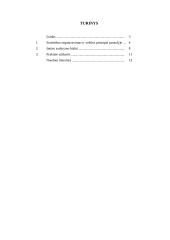
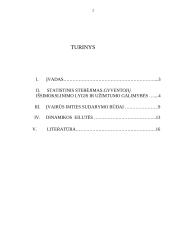
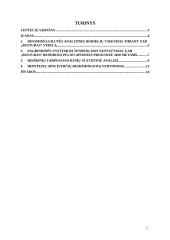
5.3. GDP by Income approach……………………………………………………………12
6. Methods, applied in practical part………………………………………………………..13
6.1. Descriptive statistics…………………………………………………………………13
6.2. Correlation and regression analysis.............................................................................14
6.3. Forecasting…………………………………………………………………………...16
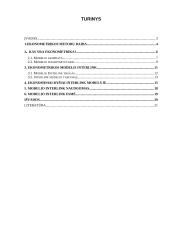
II. DESCRIPTIVE STATISTICS............................................................................................................18
III. ECONOMETRIC ANALYSIS..........................................................................................................22
1. correlation analysis..............................................................................................................22
2. Simple regression analysis…………………………………………………………………23
3. Multiple regression analysis……………………………………………………………....28
4. Forecasting…………………………………………………………………………………...30
4.1. Moving average method…………………………………………………………..30
4.2. Exponential smoothing method………………………………………………….32
CONCLUSIONS......................................................................................................................................34
REFERENCES………………………………………………………………………………………….35
INTRODUCTION
In economics, the gross domestic product (GDP) is a measure of the amount of the economic production of a particular territory in financial capital terms during a specific time period. It is one of the measures of national income and output. The Gross Domestic Product measures the value of economic activity within a country. Strictly defined, GDP is the sum of the market values, or prices, of all final goods and services produced in an economy during a period of time.
The goal of this course work is to familiarize with the most important economic measure —GDP. Moreover, the aim of this work is to survey the development of GDP of Lithuania during 1996-2004 and compare the results with other European Union countries.
The course work consists of three parts: economic theory, descriptive statistics, and econometric analysis.
The first part of the work is theoretical one in which includes theoretical analysis of GDP, the components, definitions, how it is measured, what factors may cause for GDP to fluctuate and term related to the topic of GDP are described. The methodology of calculation and formulas are also presented in this part of work
In the part of descriptive statistics, the tables and graphs about GDP and the data about chosen factors from Statistical Department of Lithuania, Finance Ministry and EUROSTAT are presented. This part also presents the descriptive statistics (median, mean, mode, variance, and other) of GDP and the factors we have chosen.
The Econometric analysis includes calculation of coefficient of correlation, simple regression analysis, multiple regression analysis which indicates how GDP depends on chosen factors (Household consumption expenditure in mln....
Šį darbą sudaro 7683 žodžiai, tikrai rasi tai, ko ieškai!
★ Klientai rekomenduoja
Šį rašto darbą rekomenduoja mūsų klientai. Ką tai reiškia?
Mūsų svetainėje pateikiama dešimtys tūkstančių skirtingų rašto darbų, kuriuos įkėlė daugybė moksleivių ir studentų su skirtingais gabumais. Būtent šis rašto darbas yra patikrintas specialistų ir rekomenduojamas kitų klientų, kurie po atsisiuntimo įvertino šį mokslo darbą teigiamai. Todėl galite būti tikri, kad šis pasirinkimas geriausias!
Norint atsisiųsti šį darbą spausk ☞ Peržiūrėti darbą mygtuką!
- Statistikos kursinis darbas
- 35 psl., (7683 ž.)
- Word failas 560 KB
- Lygis: Universitetinis
- ✅ Yra šaltiniai
 Atsisiųsti šį kursinį darbą
Mūsų mokslo darbų bazėje yra daugybė įvairių mokslo darbų, todėl tikrai atrasi sau tinkamą!
 Panašūs darbai
Kiti darbai



Privalumai
 Darbo pakeitimo garantija
Atsisiuntei rašto darbą ir neradai jame reikalingos informacijos? Pakeisime jį kitu nemokamai.
 Gauk 25% nuolaidą
Pirkdamas daugiau nei vieną darbą, nuo sekančių darbų gausi 25% nuolaidą.
 Greitas aptarnavimas
Išsirink norimus rašto darbus ir gauk juos akimirksniu po sėkmingo apmokėjimo!
Atsiliepimai