Pristatymai
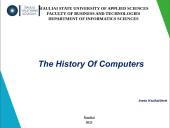
Computer History


4th Century B.C.
• The abacus, a simple counting aid, may have been invented in Babylonia (now Iraq) in the fourth century B.C.
• This device allows users to make computations using a system of sliding beads arranged on a rack.
BLAISE PASCAL
(1623 - 1662)
• In 1642, the French mathematician and philosopher Blaise Pascal invented a calculating device that would come to be called the "Adding Machine".
• One of the first and earliest mechanical devices used for calculating was the Pascaline
BLAISE PASCAL
(1623 - 1662)
• Originally called a "numerical wheel calculator" or the "Pascaline", Pascal's invention utilized a train of 8 moveable dials or cogs to add sums of up to 8 figures long. As one dial turned 10 notches - or a complete revolution - it mechanically turned the next dial.
• Pascal's mechanical Adding Machine automated the process of calculation. Although slow by modern standards, this machine did provide a fair degree of accuracy and speed.
• Only performed addition, not multiplication or division
Matiste 2015
Blaise Pascal
The stepped reckoner Supposed to be able to add, subtract, multiply, divide and calculate square roots **Device never worked properly
Gottfried Wilhelm von Leibniz
CHARLES BABBAGE
(1791 - 1871)
• Born in 1791, Charles Babbage was an English mathematician and professor.
• In 1822, he persuaded the British government to finance his design to build a machine that would calculate tables for logarithms. Called the “Difference Engine.”
• Device was to calculate numbers to 20th place and print them at 4 digits per minute.
• With Charles Babbage's creation of the "Analytical Engine", (1833) computers took the form of a general purpose machine.
Charles Babbage
1822 Babbage's Difference Engine
Analytical Engine
• 1833
• Used to perform a variety of calculations by following a set of instructions or programs stored on punch cards
• Machine only designed but never built
Joseph Jacquard
Charles Babbage
Considered the “Father of Computers”
First Computer Programmer
Ada Byron, Countess of Lovelace
Matiste...
Šį darbą sudaro 1357 žodžiai, tikrai rasi tai, ko ieškai!
★ Klientai rekomenduoja
Šį rašto darbą rekomenduoja mūsų klientai. Ką tai reiškia?
Mūsų svetainėje pateikiama dešimtys tūkstančių skirtingų rašto darbų, kuriuos įkėlė daugybė moksleivių ir studentų su skirtingais gabumais. Būtent šis rašto darbas yra patikrintas specialistų ir rekomenduojamas kitų klientų, kurie po atsisiuntimo įvertino šį mokslo darbą teigiamai. Todėl galite būti tikri, kad šis pasirinkimas geriausias!
Norint atsisiųsti šį darbą spausk ☞ Peržiūrėti darbą mygtuką!
- Anglų kalbos pristatymas
- 49 psl., (1357 ž.)
- Skaidrės 2 MB
- Lygis: Universitetinis
 Atsisiųsti šį pristatymą
Mūsų mokslo darbų bazėje yra daugybė įvairių mokslo darbų, todėl tikrai atrasi sau tinkamą!
 Panašūs darbai

Privalumai
 Darbo pakeitimo garantija
Atsisiuntei rašto darbą ir neradai jame reikalingos informacijos? Pakeisime jį kitu nemokamai.
 Gauk 25% nuolaidą
Pirkdamas daugiau nei vieną darbą, nuo sekančių darbų gausi 25% nuolaidą.
 Greitas aptarnavimas
Išsirink norimus rašto darbus ir gauk juos akimirksniu po sėkmingo apmokėjimo!
Atsiliepimai