Diplominiai darbai
Accounting principles in Lithuanian companies


On a company's balance sheet is a set of line items that are not readily definable as equity or liability-they sit in the so-called mezzanine (away from the plus and minis seating) and play the role of temporary equities. For electric companies, a mezzanine might contain anywhere from nothing to perhaps 20 percent of the total capitalization, depending on the business' capital structure.
The Financial Accounting Standards Board (PASB) wants to empty those seats and define mezzanine financial instruments as either equity or liability. Recently, for example, FASB issued Statement 150, "Accounting for Certain Financial Instruments with Characteristics of Both Liabilities and Equity," which changes the accounting for temporary equity, classifying them as liabilities.
The new rules affect an issuer's accounting for three types of free-standing financial instruments: mandatorily redeemable shares; forward contracts or written put options that require an entity to purchase its own equity shares; and contracts that obligate an entity to pay with its own equity shares in amounts that are either unrelated, or inversely related, to the price of the shares.
As the largest constituent of reported accounting information, it might be reasonable to expect revenue to be governed by a dedicated accounting standard. Not only is this not true, but it is also an international issue.
Lynn Turner, Chief Accountant at the LITHUANIA securities and Exchange Commission, describes it as the 'largest single issue involved in restatements of financial statements' (Company Reporting 2003).
Despite the importance of revenue recognition disclosures, there have been few surveys investigating the quality of existing corporate practice, and none that focuse excliusively on the property sector.
One survey (Company Reporting 2003) of LITHUANIA companies' revenue recognition disclosures found that only 62 per cent of companies disclose a revenue recognition policy.
This was a marked improvement on a previous survey by Company Reporting (2002), which found that 43...
Šį darbą sudaro 19275 žodžiai, tikrai rasi tai, ko ieškai!
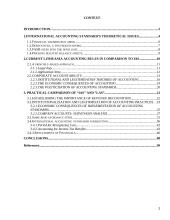
- Introduction 2
- 1.International accounting standard’s theoretical issues 4
- 1.1.Financial wizards run amok 6
- 1.2.Derivatives, a two-edged sword 7
- 1.3.FASB steps into the spotlight 8
- 1.4.Pricking bloated balance sheets 9
- 2.CURRENT LITHUANIA ACCOUNTING RULES IN COMPARISON TO IAS 10
- 2.1.A principle-based approach 11
- 2.1.1.Legal duty 11
- 2.1.2.Application Note 12
- 2.2.CORPORATE ACCOUNTABILITY 13
- 2.2.1.INSTITUTIONAL AND LEGITIMISATION THEORIES OF ACCOUNTING 16
- 2.2.2.THE ECONOMIC CONSEQUENCES OF ACCOUNTING 19
- 2.2.3.THE POLITICISATION OF ACCOUNTING STANDARDS 20
- 3. PRACTICAL CAMPARISON OF “IAS” AND ”LAS” 21
- 3.1.ESTABLISHING THE IMPORTANCE OF REVENUE RECOGNITION 22
- 3.2.INSTITUTIONALISATION AND LEGITIMISATION OF ACCOUNTING PRACTICES 23
- 3.2.1.ECONOMIC CONSEQUENCES OF IMPLEMENTATION OF ACCOUNTING STANDARDS 25
- 3.2.2.COMPANY ACCOUNTS: SURVEYAND ANALYSIS 27
- 3.3.Some risk-avoidance steps 31
- 3.4.International accounting standards jurisdiction 36
- 3.4.1.Period for Recognizing Cost 42
- 3.4.2.Accounting for Income Tax Benefits 43
- 3.4.3.Restatement of Financials 46
- CONCLUSIONS 48
- References 50
★ Klientai rekomenduoja
Šį rašto darbą rekomenduoja mūsų klientai. Ką tai reiškia?
Mūsų svetainėje pateikiama dešimtys tūkstančių skirtingų rašto darbų, kuriuos įkėlė daugybė moksleivių ir studentų su skirtingais gabumais. Būtent šis rašto darbas yra patikrintas specialistų ir rekomenduojamas kitų klientų, kurie po atsisiuntimo įvertino šį mokslo darbą teigiamai. Todėl galite būti tikri, kad šis pasirinkimas geriausias!
Norint atsisiųsti šį darbą spausk ☞ Peržiūrėti darbą mygtuką!
- Apskaitos diplominis darbas
- 53 psl., (19275 ž.)
- Word failas 217 KB
- Lygis: Universitetinis
- ✅ Yra šaltiniai
 Atsisiųsti šį diplominį darbą
Mūsų mokslo darbų bazėje yra daugybė įvairių mokslo darbų, todėl tikrai atrasi sau tinkamą!
 Panašūs darbai
Kiti darbai

Privalumai
 Darbo pakeitimo garantija
Atsisiuntei rašto darbą ir neradai jame reikalingos informacijos? Pakeisime jį kitu nemokamai.
 Gauk 25% nuolaidą
Pirkdamas daugiau nei vieną darbą, nuo sekančių darbų gausi 25% nuolaidą.
 Greitas aptarnavimas
Išsirink norimus rašto darbus ir gauk juos akimirksniu po sėkmingo apmokėjimo!
Atsiliepimai